 After years of leading worship and working in church ministry, I’ve learned that a good melody can carry a questionable statement a long way. People remember what they sing. Sometimes they remember it long after they’ve forgotten the sermon.
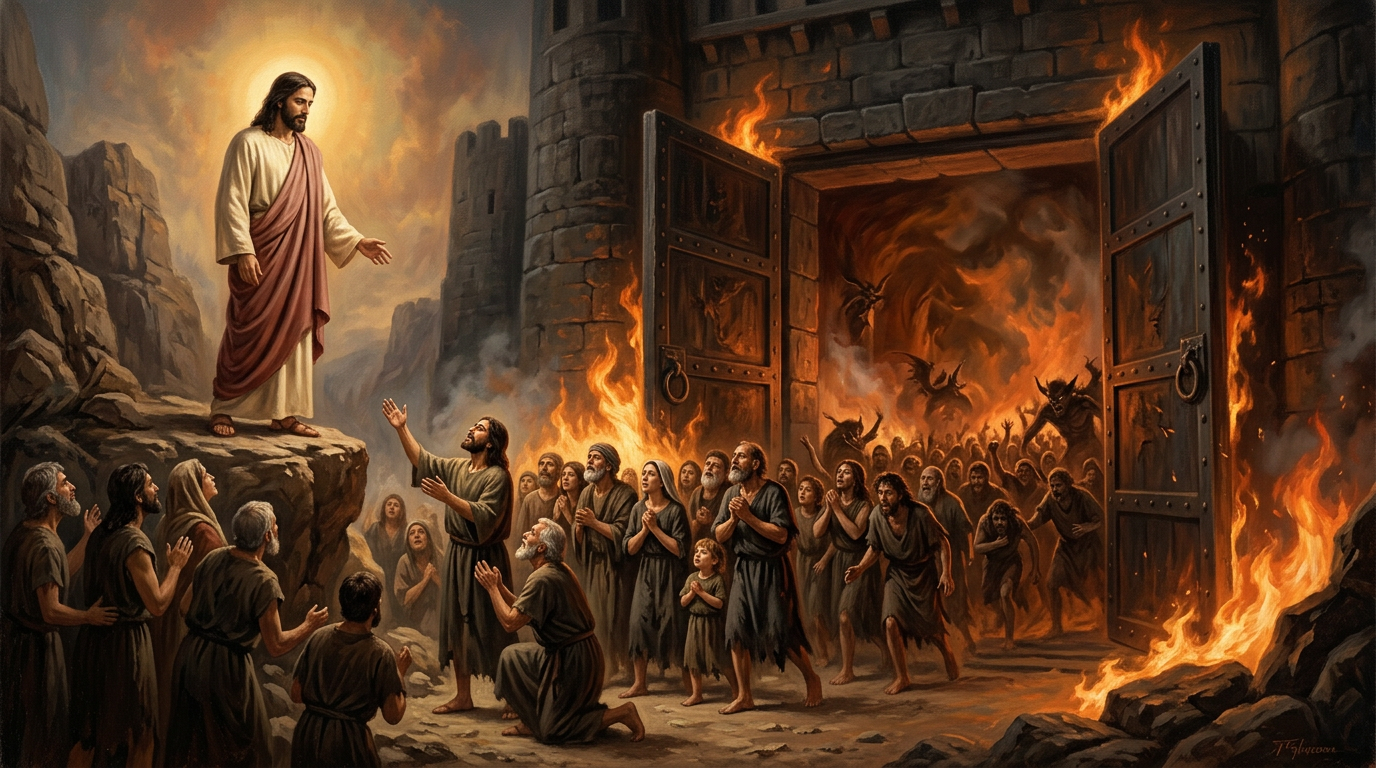
That is why a line I’ve heard in contemporary worship deserves examination: “The blood of Jesus emptied hell.”
It’s a dramatic way to celebrate Christ’s victory. I understand the appeal. But what does it mean, and where does Scripture say it happened? Those aren’t hostile questions. They’re the questions a worship leader ought to ask before putting words on a screen and asking a congregation to sing them.
Let me be clear about the issue. I believe Christ’s blood secured our redemption. I believe He rose from the dead and defeated the power of death. What I cannot find is a passage saying His blood emptied hell. We should not confuse those claims.
The Keys of Death and Hades
In Revelation 1:18, the risen Jesus declares that He has “the keys of death and of Hades” (NASB 1995). That tells us who has authority. It does not tell us that Hades has been emptied.
The word Hades commonly refers to the realm of the dead. Gehenna, another New Testament term often translated as hell, is associated with final punishment. English speakers frequently put both under one word, hell, and then wonder why the passages seem confusing.
If a lyric says Jesus emptied hell, I want to know which meaning is intended. The realm of the dead? The place of final punishment? Or simply the power of death? Each answer leads to a different theological discussion.
What About the Captives?
Ephesians 4:8–10 says Christ “LED CAPTIVE A HOST OF CAPTIVES” and refers to His descent into “the lower parts of the earth” (NASB 1995). Some Christians have understood that descent as a journey to the realm of the dead, followed by the liberation of the righteous. Others understand it as Christ’s coming to earth in the incarnation. There are reasons offered for both readings.
But Paul’s subject in Ephesians 4 is the exalted Christ giving gifts to His Church. The passage does not say that every occupant of hell was released. That conclusion is not in the text.
First Peter 3:18–20 is also cited. Peter says Christ made proclamation to “the spirits now in prison” (NASB 1995). Interpreters disagree about who those spirits were and when the proclamation took place. Some understand a declaration of victory to imprisoned spirits. Others understand Christ preaching through Noah. Still others connect it with Christ’s descent to the dead.
Whichever view you hold, Peter does not explicitly say that the prison was emptied. A proclamation and a release are not the same event.
An Old Teaching That Needs Careful Explanation
The historic teaching called the Harrowing of Hell describes Christ descending to the dead and liberating the righteous who awaited redemption. It is an important part of some Christian traditions, though its details and biblical basis remain debated.
Even that teaching should not be casually rewritten as “Jesus released everyone from hell.” Many who affirm Christ’s descent distinguish the righteous dead from those under final condemnation. The distinction isn’t a technicality. It changes the meaning of the claim.
This Isn’t a New Idea
Interestingly, the idea of Christ emptying hell isn’t something contemporary worship writers invented. It reaches back to the early centuries of Christianity.
Ephrem the Syrian, a fourth-century Christian theologian, poet, and hymn writer, used strikingly similar language in a hymn traditionally attributed to him:
“The Living by His death emptied Hell.”
Ephrem’s words reflect an ancient Christian understanding of Christ’s descent into the realm of the dead and His victory over death. This understanding eventually became closely associated with what Christian tradition calls the Harrowing of Hell, the belief that Christ descended to the dead and liberated the righteous who awaited redemption.
That’s important historical context. It tells us the imagery has been part of Christian thought for centuries. But we need to make a distinction.
The fact that an idea appears in ancient Christian hymnody does not, by itself, establish its biblical accuracy.
Ephrem’s language deserves to be understood within its historical and theological setting. The word translated as hell in older Christian writings does not necessarily refer to the place of eternal punishment. It can refer more broadly to the realm of the dead.
That distinction matters when modern congregations sing similar words without explanation.
My concern, therefore, isn’t that contemporary songwriters have invented an entirely new doctrine. It’s that an ancient and theologically complex idea can be reduced to a memorable lyric, leaving congregations to draw conclusions that Scripture itself may not support.
Church history helps us understand where the language came from. Scripture must still determine what we teach as truth.
When Does Hades Give Up Its Dead?
Revelation 20:13 says that “death and Hades gave up the dead which were in them” (NASB 1995). Verse 14 then pictures death and Hades thrown into the lake of fire. Here we actually have language about Hades surrendering its dead. But the setting is the final judgment, not the crucifixion.
Revelation uses apocalyptic imagery, so I wouldn’t build an elaborate timetable from one verse. Still, it hardly serves as a direct reference for the claim that Jesus emptied hell at Calvary.
Why I Care What the Church Sings
Some will say I’m pressing a poetic lyric too hard. Perhaps the songwriter meant only that Christ decisively conquered death. That’s a fair possibility. The Psalms certainly show us that worship can use bold images without speaking in technical theological language.
But poetic language still teaches. And congregational music is not exempt from biblical scrutiny simply because it has a strong chorus.
Colossians 3:16 joins singing with “teaching and admonishing one another with psalms and hymns and spiritual songs” (NASB 1995). Music has a teaching function. Anyone who has served in worship ministry knows how thoroughly repeated lyrics settle into people’s thinking.
I’ve seen congregations sing lines enthusiastically that they would struggle to explain afterward. That’s not a reason to stop singing. It’s a reason to select songs more carefully.
Worship leaders, can you explain the words you’re asking people to sing? Can you point to Scripture and show how the lyric follows from it? Would you be comfortable if a pastor made the same statement in a sermon without qualification?
And to those in the pews, do you listen to what you’re singing? Do you ever compare those words with the Bible, as the Bereans examined what they heard in Acts 17:11?
I’m not calling a songwriter a heretic over one line. Nor am I denying that a figurative meaning may be intended. I am saying the phrase is ambiguous and has no direct biblical statement behind it. That’s enough reason to ask for clarity.
Hebrews 2:14–15 and 1 Corinthians 15:54–57 already give us magnificent language for Christ’s victory over death. We don’t need to improve on it.
Our responsibility is not to make Christ’s victory sound bigger than Scripture does. Our responsibility is to tell the truth about it.